Cybersecurity Branding: Why Technical Companies Are Investing in Design
Cybersecurity branding has a problem: buyers judge your company before they read a single word about your product, and a lot of security brands still look exactly alike.
I have spent most of this year on calls with deep-tech founders. People who can explain identity architecture for forty minutes straight without checking their notes, building products that have never had a designer in the room. When I picture the category they sell into, I see a sea of sameness: mostly shields and locks, almost all of them blue.
That's changing. The cybersecurity companies that figured out branding early aren't winning because their product got better. They're winning because buyers can finally tell what the product does.
At Flexxi Studio, my team and I build brands and products for technical teams like Orchid Security. In this article, I look at why cybersecurity branding has become a buying factor and how to check whether your own brand stands out.
Why do cybersecurity brands all look the same?
Cybersecurity brands look the same because they're usually built late, from a feature list, by people describing the category instead of the company.
At an early-stage security company, the people who understand the product best are engineers. Design isn't a priority yet. When the brand finally gets built, it borrows the visual codes everyone already uses for "secure", and the company ends up looking like its competitors.
The result is a category full of dense documentation and interchangeable promises about protection. If every vendor says the same thing in the same blue, the buyer has nothing to remember you by.
What can cybersecurity companies learn from Wiz's branding?
Wiz showed that a cybersecurity company can win partly by refusing to look like one. Its brand uses pink gradients and playful illustrations in a category built on dark, serious visuals, and people actually remember it.
The business results speak for themselves. Wiz was founded in 2020 and reached $100 million in annual recurring revenue just 18 months after hitting $1 million, which the company reported as the fastest of any software company. In March 2026, Google completed its $32 billion acquisition of Wiz, the largest deal in its history.
Wiz's product is excellent. So are its competitors' products. The difference is that Wiz decided cloud security didn't have to look like cloud security, and the rest of the category is still catching up.
It isn't alone. Vanta, 1Password and Orchid Security all sell to the technical buyer, and none of them looks like a classic security company. In a crowded market, these are the names people describe as well made.
So now there's a bar. Your buyer sees Wiz, then sees you, and decides what they think of your company before reading anything about your product. Unfair, maybe. Happening anyway.
Why are marketing and design teams merging at technical companies?
Marketing and design are merging at technical companies because buyers experience the brand, the website and the product as one thing.
Your website is where someone decides what they think of you. Your product is what they see ten minutes later. If those two were built by different people on different timelines, everybody can tell.
The best technical companies have stopped splitting this into a marketing team and a design team. One group owns the website, the product screens, the sales deck, all of it. Two years ago, this was a next-year problem for most security teams. Now it comes up in the first budget conversation.
Orchid Security case study: cybersecurity branding built on what the product does
Orchid Security came to us with a product that does something hard. It goes into your applications and pulls out the identity logic nobody has looked at in years: every access rule, every permission, every account someone set up in 2019 and forgot about. Think of it as the closet you've been avoiding, except the closet is your entire company.
Identity security isn't a space people associate with good design. That's exactly why it's a chance to stand out.
Orchid already knew that. Their marketing leader came from Wiz. She had watched a technical company win partly by refusing to look technical, and she brought that standard with her.
So we didn't ask how to make Orchid look secure. We asked what the product does before it protects anything. The answer: it finds what nobody can see. That became the concept for the brand, dark matter.
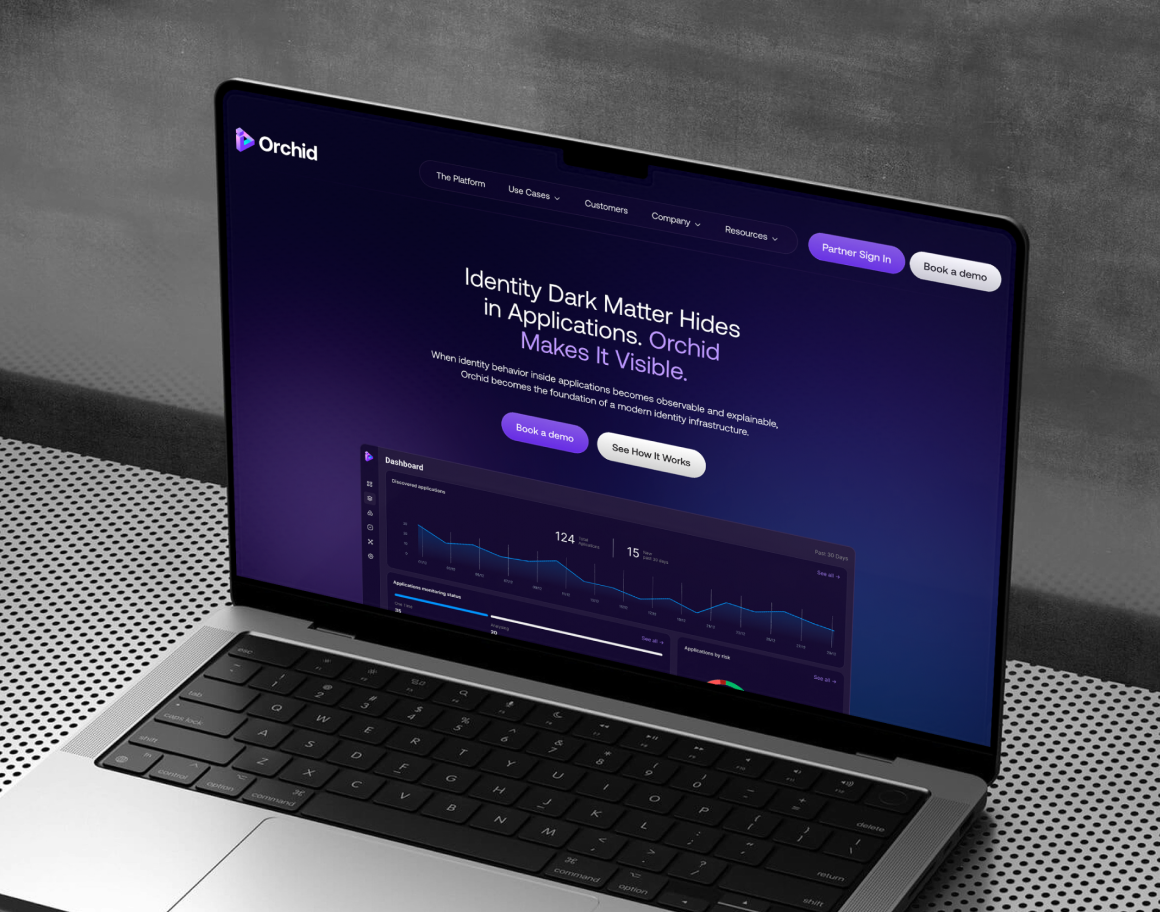
Everything came from there: layered compositions and network-shaped structures that reveal more depth as you scroll. The website works the way the product works, uncovering one layer at a time. Instead of describing the product, the site performs it.
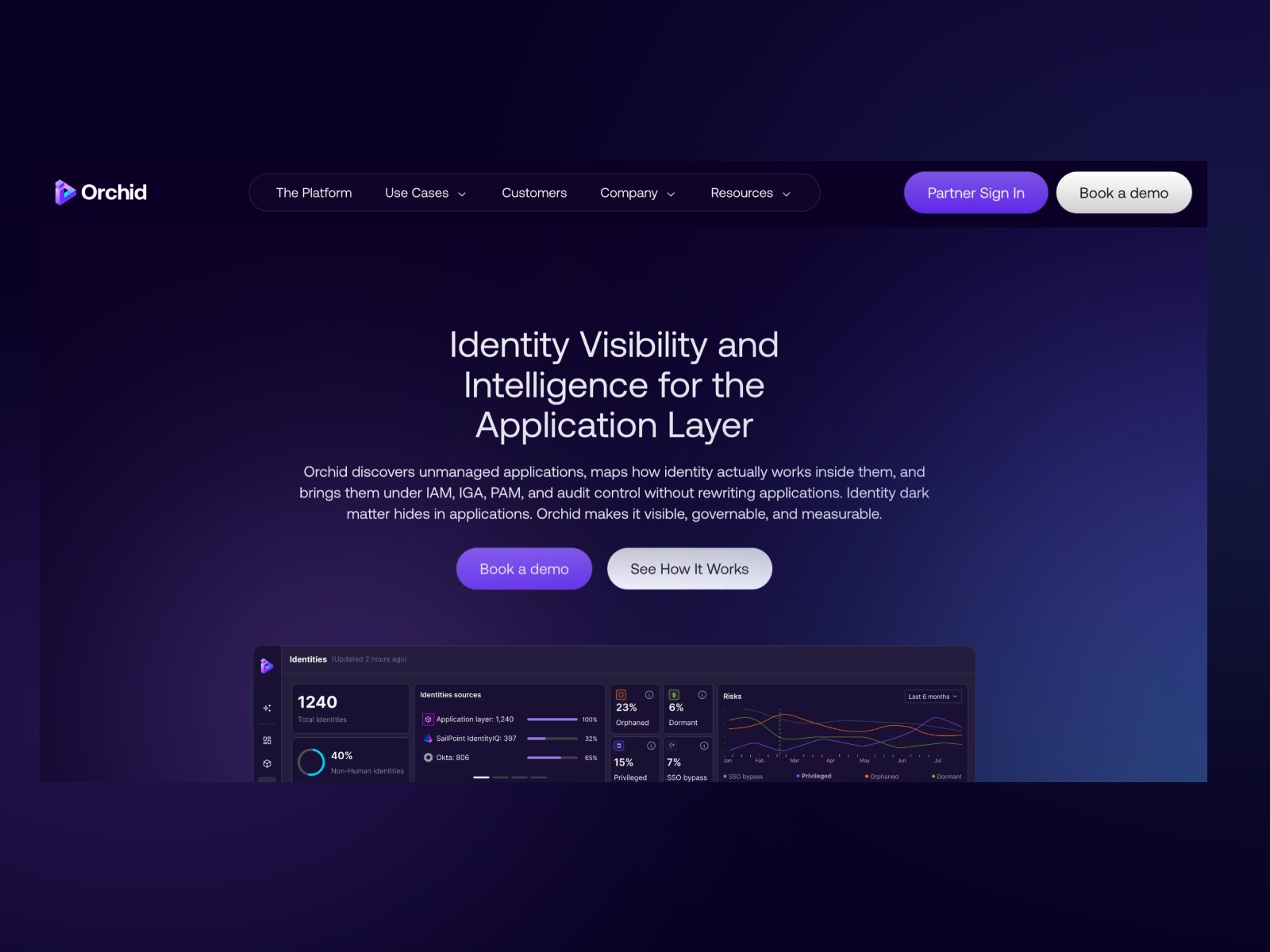
The most important part: the marketing work and the design work never ran as separate projects. We built the brand, the website and the design system as one thing, with Orchid's team in the room the whole way through. There was no handoff where marketing receives a brand kit and has to figure out what to do with it, and no separate version of the brand quietly appearing inside the product six months later.
Because Orchid treated design as something to build early instead of clean up later, we moved fast. A few years ago, I was still making the case for why this matters. Now technical companies show up already thinking this way. You can see the full project in our brand and product design case studies.
How to tell if your cybersecurity brand stands out
Here's the test I give every technical team: put your website next to your three closest competitors with the logos covered. If you can't tell which one is yours, your buyer can't either.
That's a positioning problem before it's a design problem, and new visuals alone won't fix it. If the test goes badly, these are the principles my team works from:
Start with what the product does, not the category. Orchid's brand came from "it finds what nobody can see", not from what identity security usually looks like.
Build the brand and product as one system. When they come from one team and one idea, the buyer gets the same company on every screen.
Bring design in early. A brand built from a feature list after launch will describe the category. A brand built alongside the product can describe the company.
Let the website show the product. If your product reveals or connects something, the site can do the same thing as people scroll.
Want more on design for technical companies?
Every issue of my newsletter, Flexxible by Design, brings real stories from client work and what I'm learning along the way.
Subscribe to Flexxible by Design →
Frequently asked questions
What is cybersecurity branding?
Cybersecurity branding is how a security company shows buyers what it does and why it's different, through its positioning, visual identity, website and product experience. Strong cybersecurity branding makes a technical product easy to understand and easy to remember.
Why is branding important for cybersecurity companies?
Branding matters because buyers form an opinion of a security company before they read about its product. In a crowded category where most vendors make similar promises, a clear brand is often what separates a shortlisted company from an ignored one.
How do you differentiate a cybersecurity brand?
Start from what your product does that nobody else's does, not from the visual codes of the category. Then build the brand, website and product design around that one idea so every touchpoint tells the same story.
What makes a good cybersecurity website?
A good cybersecurity website makes it obvious what the product does within seconds, looks different from competitors and matches the product experience buyers will see next. The best ones show how the product works instead of only describing it.
Is a weak brand a positioning problem or a design problem?
Usually it's a positioning problem first. If you can't tell your website apart from competitors with the logos covered, new visuals won't fix it until the message underneath is clear and specific.
How did Wiz's brand stand out in cybersecurity?
Wiz chose bright pink gradients and playful illustrations in a category known for dark, blue, serious visuals. That made the brand instantly recognizable while the company grew to a $32 billion acquisition by Google.
Building a brand for a technical product?
My team and I build brands and design systems for cybersecurity and deep-tech teams, as one system. If you ran the logo test and didn't love what you saw, I'd love to hear about it.
Sources
- Wiz, $100M ARR in 18 months: Wiz becomes the fastest-growing software company ever
- TechCrunch, Cloud security startup Wiz reaches $100M ARR in just 18 months
- Techzine, Google closes $32B Wiz deal, its largest acquisition ever
Related reading
- Why Users Don't Trust AI With Their Money (And How Product Design Fixes It)
- Expanding Design Systems at AstroPay
- How Design Turned Session Replays into Insight Engines
Want more on design for technical companies? Subscribe to my newsletter, Flexxible by Design →
Notifications and Alerts